Cupid Errands:
route with evidence.
An automation demonstrator for structured AI email classification and deterministic departmental routing. The system is a tested portfolio workflow, not a claim of production-ready enterprise email infrastructure.
Architecture and decision boundaries
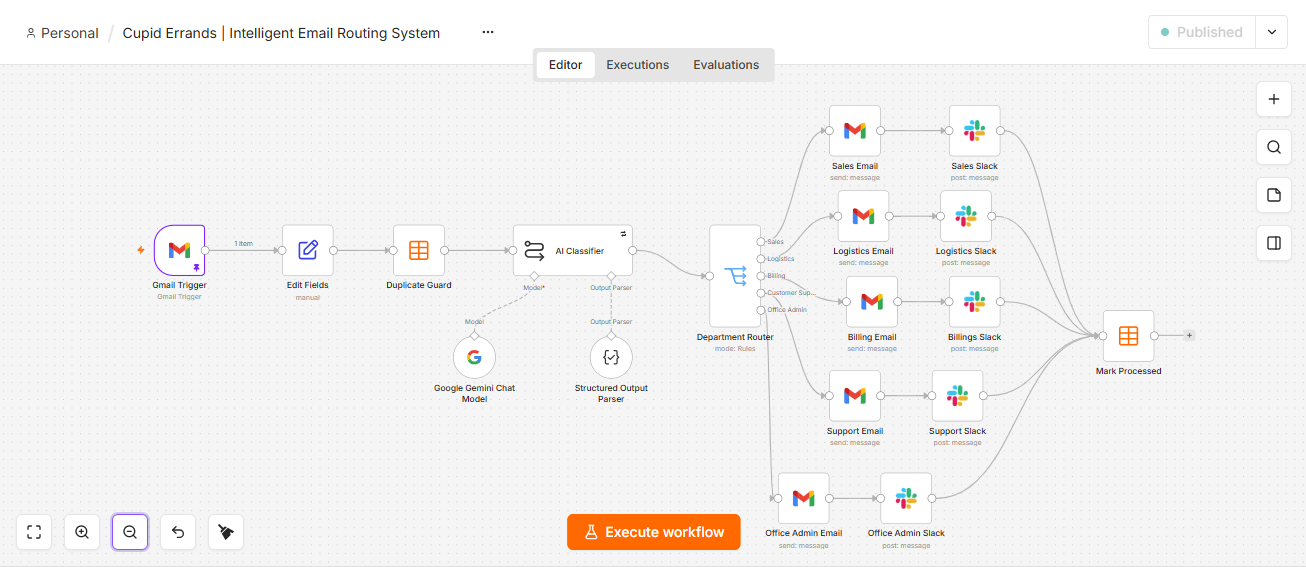
A dedicated Gmail trigger captures messages, then Edit Fields normalizes the incoming request.
Gemini with a structured output parser returns a department and supporting fields.
An n8n Switch chooses a department, followed by Gmail and Slack actions.
This workflow includes a duplicate-guard lookup and a processed-state update. Its existing execution screenshots and narrated walkthrough support a portfolio demonstration, but the current public repository does not include a sanitized executable n8n export.
What was tested and what remains open
| Area | Evidence | Current limitation |
|---|---|---|
| Five department routes | Recorded execution evidence and public walkthrough | Not a regression suite |
| Duplicate-guard behavior | One documented duplicate suppression test | Concurrent message races not proven safe |
| Gemini temporary failures | Retry configuration described in the project | Dead-letter and incident-alert handling not demonstrated |
| Low confidence | Output includes a confidence field | Separate confidence-threshold gate needs verification or implementation |
How this becomes stronger
Add a deterministic confidence gate with explicit ambiguous-input behavior.
Use an atomic unique record before notifications to prevent concurrent duplicate sends.
Reconcile partial failures, capture dead-letter events and alert after final retry.
Publish a sanitized workflow export, test scenarios, expected decisions and an evidence index.
These are proposed remediation steps. They are not represented as already implemented.
What learners can reproduce
Start with a deterministic router before adding AI classification. Compare the model's suggested department against a validated list, avoid automatic external actions when classification is uncertain, and test retry and duplicate-delivery scenarios.